

AgiBot Proposes 'Worken' Metric to Measure Actual Robot Labor Output
By Xiong You Di
Following the deployment of over 300 robots at Chimelong, AgiBot introduced the "Worken" metric to evaluate actual labor output rather than mere deployment numbers, highlighting the ongoing challenge of scaling on-site engineering support.
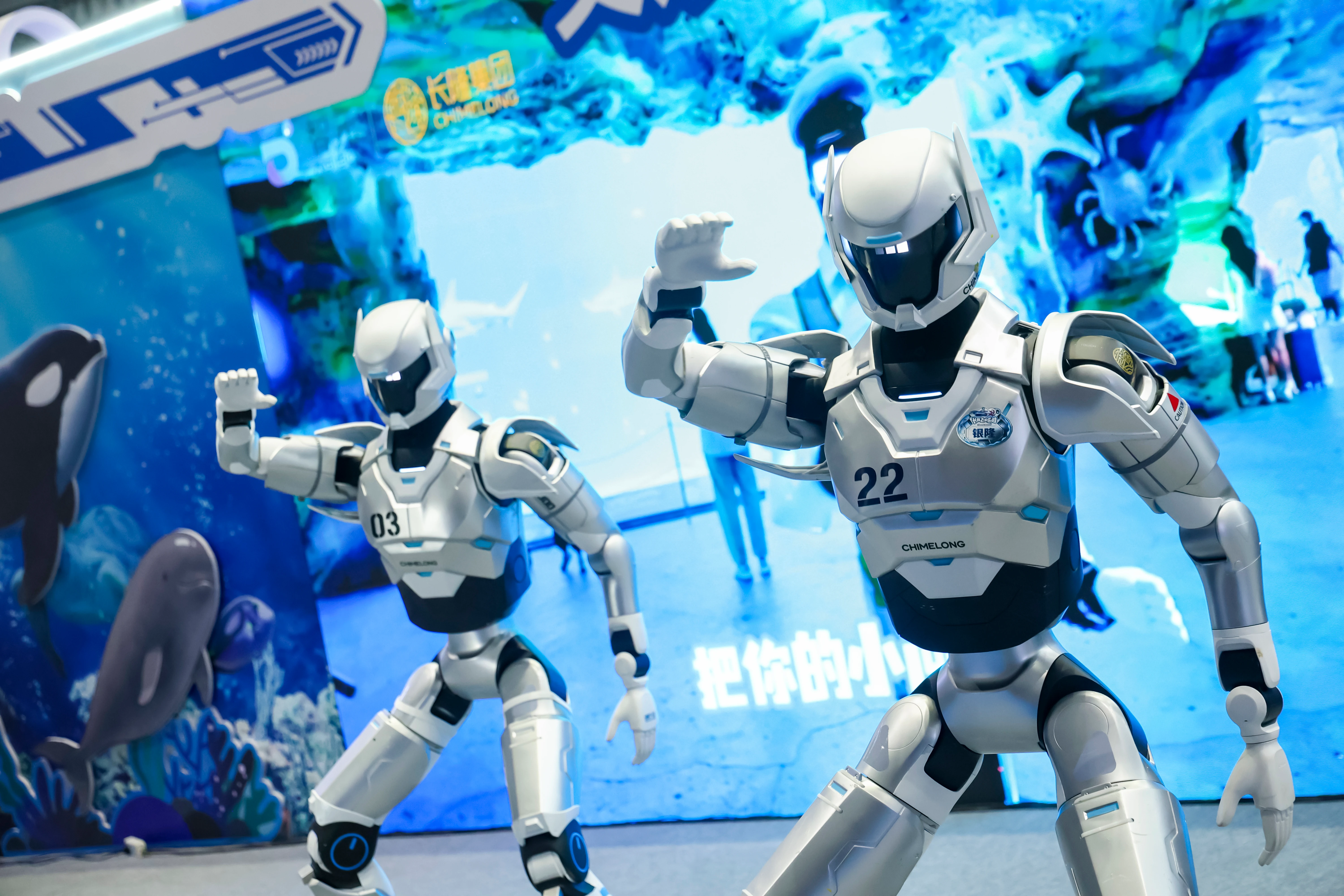
More than 300 robots have been deployed at Zhuhai Chimelong Spaceship. Visitors see robots giving tours, playing rock-paper-scissors, and playing table tennis. What they don't see is the other team working behind the scenes.
During AgiBot Innovation Day on October 29, Wang Chuang, AgiBot partner and senior vice president, recalled that the Chimelong project initially required an almost 1:1 ratio of robots to engineers. These robots were distributed across more than 100 locations with different tasks and environments. Equipment failures, show updates, network connectivity issues, and unexpected actions from visitors all required human intervention.
This experience unfolded against the backdrop of robots gradually achieving a more substantial revenue scale. At the main forum that same day, Peng Zhihui, AgiBot co-founder, president, and CTO, disclosed that the company's revenue in the first half of 2026 approached RMB 2 billion, and its 20,000th robot rolled off the production line in September this year.
On Innovation Day, AgiBot also released a new generation of embodied manipulation models, interaction models, heavy-duty robots, and an operating system. Beyond new products and technologies, AgiBot introduced a new concept: Worken. According to AgiBot's definition, Worken = number of active robots × autonomous working hours × output efficiency ratio. The company hopes to use this metric to measure the actual labor provided by robots, rather than just counting how many units are manufactured and deployed.
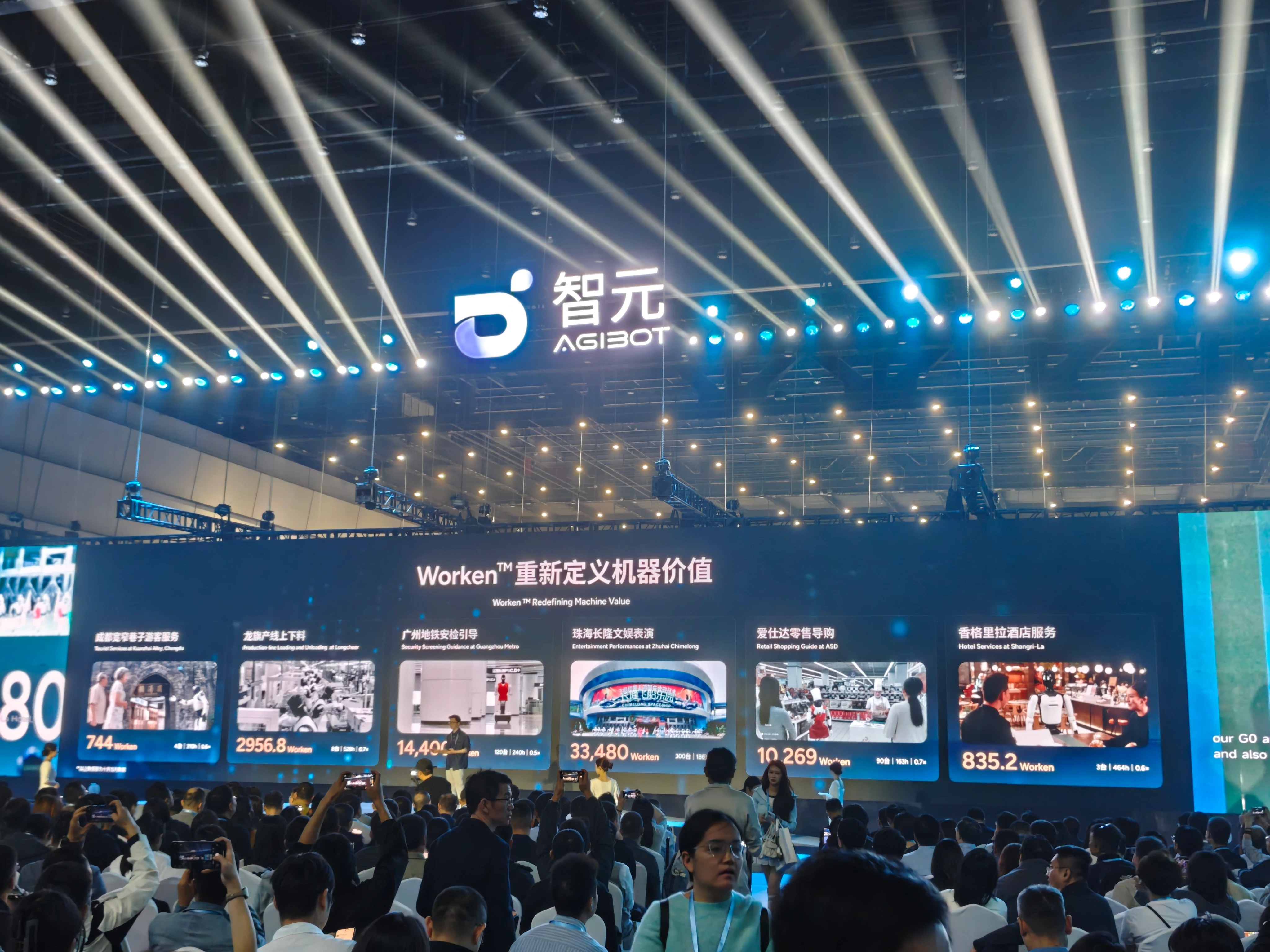
After competing on shipment and deployment volumes, the robotics industry is shifting its focus from the number of devices to actual labor output to prove its commercial value.
Over 300 Robots Deployed, but the Real Challenges Are Just Beginning
On September 24, the first batch of more than 300 robots from the collaboration between AgiBot and Chimelong began operations at Zhuhai Chimelong Spaceship. Unlike robots in a factory repeating the same process, these robots are distributed across various locations. Some are responsible for giving explanations, some play games and table tennis with visitors, and others handle guiding tours and other interactive tasks.
In a lab, a robot completing a single action can be called a capability demonstration. But in a theme park, the client needs many devices to operate normally every day. Which robot at which location is out of battery, which device has thrown an error, which content needs adjustment, and who handles it when an anomaly occurs—these have all become operational issues.
Humans are an even more unpredictable variable. Wang Chuang noted that children sometimes suddenly hug or push the robots, while other visitors fail to follow the interaction rules. These unpredictable behaviors impact both task completion and equipment safety. Around the National Day holiday, AgiBot collected more than 10,000 operational data points from the site to iterate on its software and models. Meanwhile, the heavy presence of robots sharing the network environment with visitors placed new demands on edge-cloud collaboration, prompting AgiBot to participate in building a dedicated network for the robots.
These investments demonstrate that customers are purchasing more than just a performing robot; they also require comprehensive management, maintenance, safety, and content update capabilities to support it.
According to Wang Chuang, the number of robots in the Chimelong project has grown from an initial batch of over 300 to approximately 500, with plans to scale up to 1,000 by the end of the year. While a larger fleet expands service coverage and generates more user feedback, the per-unit operating cost does not necessarily drop. If every new batch of robots requires a proportional increase in on-site engineers, scaling up will simply drive labor costs higher.
The replicability of such projects cannot be judged merely by counting how many robots are packed into a single park. The true test is whether the tasks that previously required on-site human intervention can be progressively reduced once new deployment points go online.
Two Dimensions of Labor Efficiency: Deployment Speed and Operational Density
Following system debugging and operational optimizations, Wang Chuang stated that the robot-to-engineer ratio at the Chimelong site has improved from an initial 1:1 to approximately 3:1. His target is to reach a 10:1 ratio by the end of 2026, and 20:1 by 2027.
Achieving this shift requires more than just cutting on-site headcount. For a single engineer to support multiple robots simultaneously, the hardware must be highly reliable to ensure rapid fault localization when issues arise. Task configurations for new deployment points should reuse existing templates rather than being developed from scratch. Additionally, certain exceptions must be manageable remotely by the headquarters team.
Wang Chuang noted that AgiBot has built a unified robot operations and management system. On-site personnel can reuse task templates created by experts, while complex issues are escalated to the headquarters team for remote support. The reduction in on-site engineers reflects a broader shift: work is transitioning from physical on-site presence to software tools, remote operations, and backend technical teams. In other words, every engineer removed from the site is compensated for by more reliable hardware, more mature software, and robust backend engineering systems.
Wang Chuang ran the numbers: at a 20:1 ratio, this equates to the customer needing only a 5% increase in the labor budget for this position. "For many customers, 5% is an acceptable threshold."
The logic for withdrawing human workers differs in industrial settings. According to Yao Maoqing, co-founder and co-president of AgiBot, in Longche's tablet inspection loading and unloading project, AgiBot's R&D team has already withdrawn from the site, leaving basic software operations and maintenance to Longche's on-site team. The solution is now expanding beyond the original tablet products to include loading and unloading for testing other tablet brands and smartphones.
Beyond operating costs, deployment costs cannot be ignored.
Yao Maoqing argues that a key metric for measuring deployment efficiency is the exact number of person-days required to adapt to a similar new scenario. He drew a comparison to autonomous driving: top-tier solution providers can deploy a new vehicle model with a 10-person team in three months, while less efficient ones might require 100 people working for a year to achieve the same. The robotics industry faces the same reality. Setting up the first workstation involves retraining models, modifying equipment interfaces, integration, and acceptance testing—all of which represent R&D and engineering investments. If onboarding each new customer requires reinvesting the same amount of manpower, it becomes difficult to transition from project-based work to a scalable, replicable business.
This actually reflects two distinct types of labor efficiency. During the deployment phase, the metric is how quickly a team can master a new scenario; during the operations phase, it is how many robots a single operator can continuously support. The former dictates the speed of order replication, while the latter determines operational density and long-term service costs.
Worken measures how much effective labor these investments ultimately yield.
8 hours does not equal 8 hours
Worken's three multipliers correspond to the number of robots actually deployed on the floor, the duration they can operate autonomously, and the output efficiency of the labor they perform.
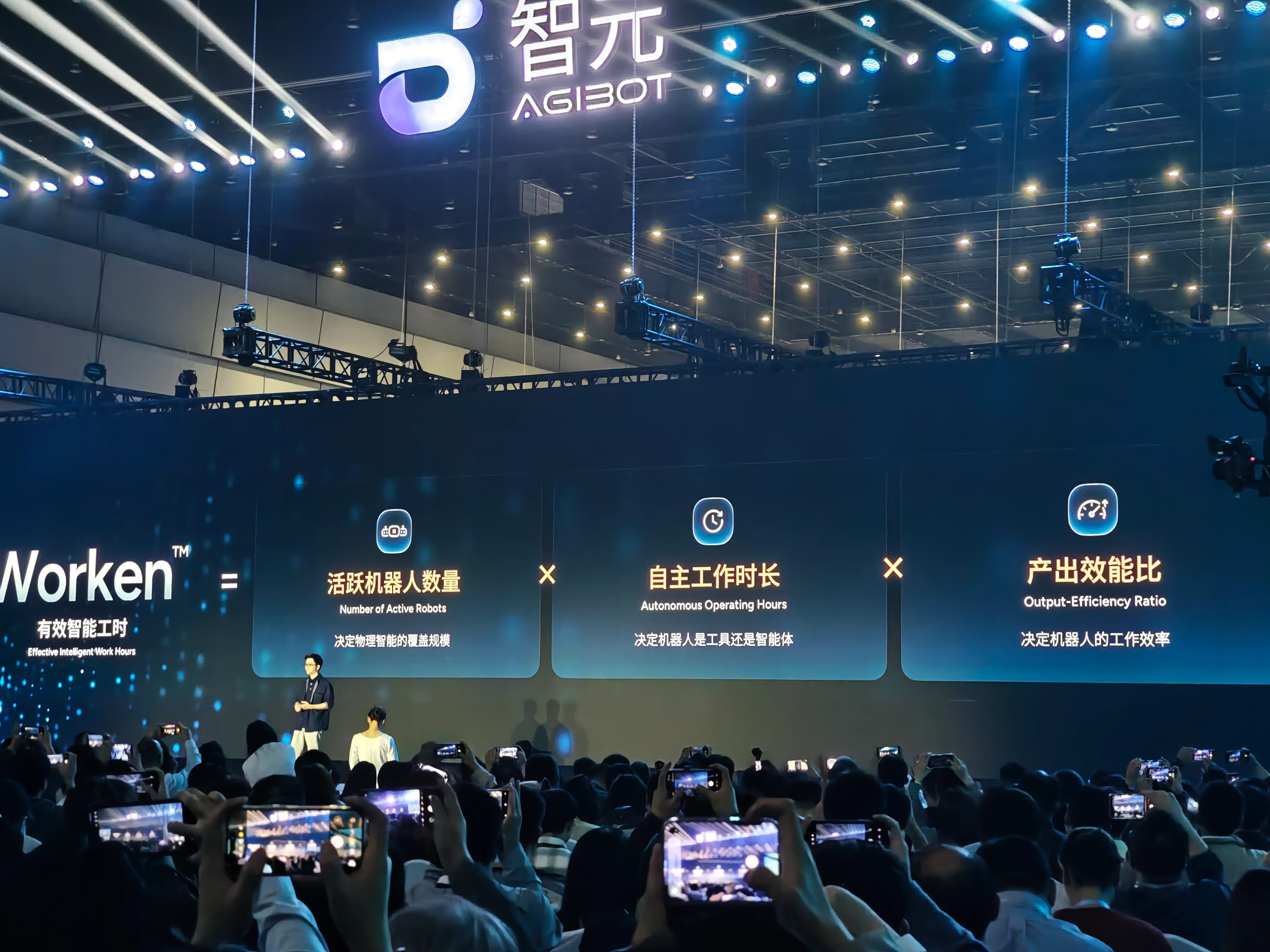
To some extent, all three factors apply a discount to human intervention. Machines requiring human activation do not count. Work hours requiring human takeover are discounted, and if the robot cannot match a human worker's efficiency, the value is discounted even further.
Meanwhile, the number of active robots and their autonomous work hours are relatively easy to measure. The truly difficult metric to define is the final one: the output efficiency ratio.
Wang Chuang admits that the "value density" of labor remains difficult to quantify. He cites the example of a receptionist whose duties include greeting guests, handling luggage, guiding visitors, and seeing them off—a highly varied set of tasks. Currently, a robot can handle only two out of ten such tasks, which is already a solid achievement. On the other hand, many of these roles operate on two- or three-shift schedules. A human worker standing for eight hours becomes exhausted, whereas a robot can remain on duty continuously. Simply equating eight hours of robot operation to eight hours of human work clearly fails to capture the actual differences in the tasks completed.
This issue becomes even more pronounced when comparing industrial and service scenarios.
On industrial production lines like those at Longqi, metrics such as the number of successful material loading and unloading cycles, whether takt time meets standards, and whether faults disrupt production can all be tracked as clear production indicators. Wang Chuang notes that in tablet loading and unloading scenarios, AgiBot trains its robots to achieve a task success rate of at least 99.9% before integrating them into the production line, followed by continuous improvement.
However, in service environments such as theme parks and hotels, robots may provide guided tours, interactive engagement, reception duties, and a certain degree of experiential value. Beyond measuring how much repetitive work the robot replaces, clients also care about business outcomes like visitor utilization rates, satisfaction scores, and incremental spending. These intangible values cannot be captured solely by the number of hours the robot is on duty.
This is why Wang Chuang believes that deployment in interactive service scenarios may advance faster than in industrial settings. Industrial clients impose stricter requirements on takt time, stability, and cost, whereas service clients apply more diverse evaluation criteria.
For robot manufacturers, an increase in the time a robot spends autonomously completing tasks yields a dual benefit: on one hand, the labor output measured by Worken increases, and on the other, the frequency of on-site interventions and maintenance decreases. A single improvement in autonomous capability presents an opportunity to simultaneously enhance output and reduce costs.
From Selling Equipment to Selling a Commitment to Labor
For robotics companies, how labor output is measured will ultimately shape their pricing models.
Wang Chuang noted that AgiBot currently focuses primarily on selling robots and comprehensive capability packages, often bundled with maintenance, development, and service agreements. Its leasing business, meanwhile, charges mainly by the day or per event. Looking ahead, he envisions offering customers a robot "productivity package," where pricing is based on task complexity and Worken consumption.
Overseas, some companies have already entered real-world commercial operations using a Robot-as-a-Service (RaaS) model. In June 2024, Agility Robotics signed a multi-year RaaS agreement with logistics provider GXO, deploying its humanoid robot Digit alongside the cloud management platform Agility Arc in a warehouse. Digit handles bin transportation, while Agility Arc manages the robot fleet and integrates with the customer's operational systems.
On October 26 of this year, the two companies announced an expanded partnership, planning to deploy Digit to two additional U.S. warehouses starting in early 2027. According to joint disclosures, the Digit units in the original Georgia warehouse have moved more than 100,000 bins to date. However, during an earnings call in August, GXO noted that while it has launched 45 humanoid robot pilots, it has not yet achieved a return on investment from these applications. For actual customers, continuing to explore or scaling up deployments is a very different proposition from a project that already makes clear economic sense.
Unlike one-off hardware sales, providing continuous robotic services requires manufacturers to focus on long-term equipment operation and maintenance. Agility has not only built a cloud management platform but also partnered with Ricoh to develop deployment, repair, and technical support systems, aiming to scale the rollout of more robots to customer sites.
As robot deployments scale from single projects to multiple sites, manufacturers need more than just additional hardware; they require management and service frameworks that can be replicated across locations. Otherwise, a growing robot fleet will simply require a proportional increase in on-site support staff.
RaaS relies on a subscription logic that customers already understand, whereas billing by Worken requires establishing an entirely new measurement standard first. For AgiBot, the Worken package will need to be rolled out gradually. Before this metric can truly become a pricing standard, it must win customer validation of its value and withstand rigorous testing across deployment, operations and maintenance, and liability-sharing mechanisms.
Whether Worken can evolve from an internal KPI at AgiBot into an industry-recognized standard of measurement ultimately depends on who establishes the baseline for output efficiency and whether operational data can be independently verified. Until these questions are answered, it remains simply AgiBot's own yardstick.