

AGILINK Cuts Dexterous Hand Failure Rate to 0.5% for Industrial Deployment
By Xiong You Di
At AgiBot's Innovation Day on October 29, AGILINK demonstrated a production testing station via a cross-city link, where a dexterous hand used a screw gun to test another unit awaiting factory release. At the company's joint manufacturing base with Wolong in Shaoxing, the robot executes 72 operational steps, including material loading, barcode scanning, clamping, screw tightening, equipment activation, and unloading.
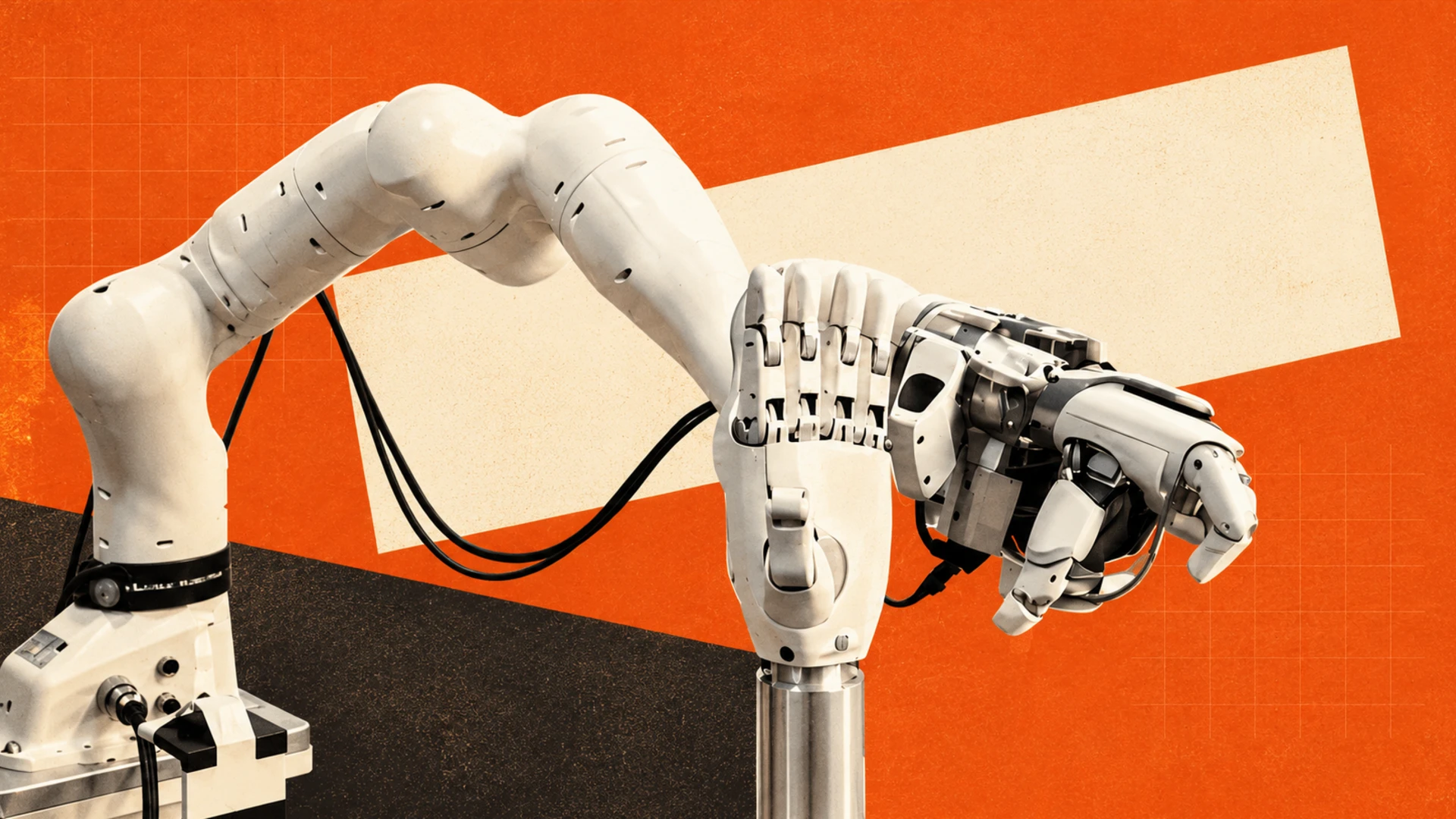
A dexterous hand picks up a screw gun to perform a performance test on another dexterous hand awaiting factory release. This is a production testing station demonstrated by AGILINK via a cross-city live link at the Dexterous Manipulation sub-forum of AgiBot Innovation Day on October 29.
At the AGILINK Wolong joint manufacturing base in Shaoxing, the robot must complete 72 operational steps, including loading, barcode scanning, clamping, fastening, starting the test equipment, and unloading. According to the company, the task success rate during the Phase 1 proof-of-concept (POC) validation was 98%, with a single cycle taking 8.5 minutes, compared to 8 minutes for a skilled human worker performing the same task; the equipment can operate continuously for 8 hours.

Moving from workstation validation to formal integration into the production line, this solution still requires further advancement. The company expects the workstation to be integrated into the production line by the end of the year.
Following the sub-forum, AGILINK CEO Qiao Tianjie, Chief Scientist of Embodied AI Huang Bidian, and Director of Model Algorithms Wu Mingdong granted interviews to multiple media outlets, including 42HOW Robotics.
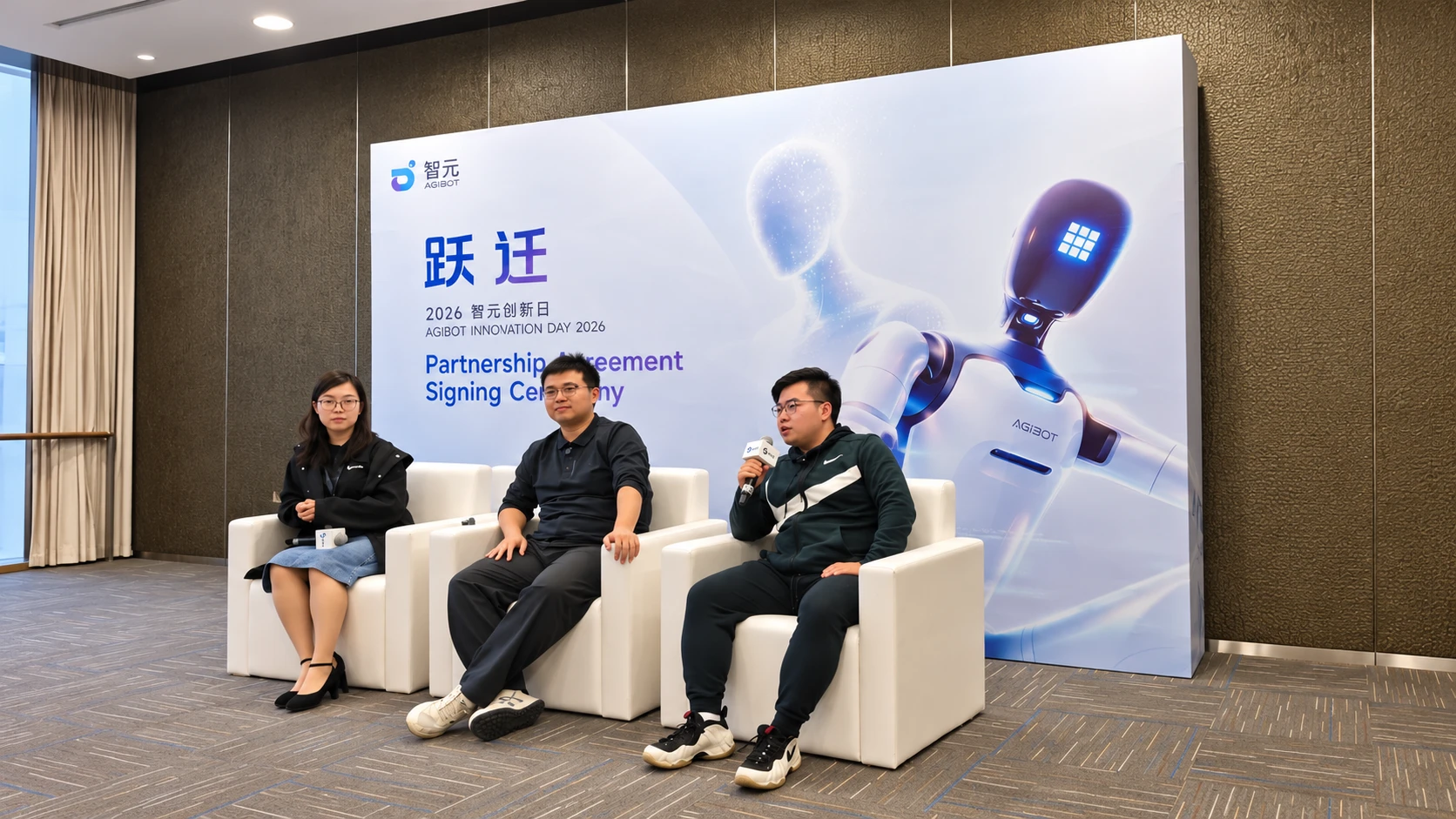
"Our goal for deployment is to complete a full shift, not just a single step," Wu said. In his assessment, continuous operations involve steps that parallel grippers struggle to complete, presenting an opportunity for dexterous hands while also placing higher demands on their reliability and control capabilities.
AGILINK's strategy is to advance in stages: deploying medium- to low-DOF products for early adoption while expanding into manipulation algorithms and data collection, aiming to make it easier for customers to utilize the dexterous hands. However, as the system moves from a single workstation to more scenarios, questions remain about how much manipulation capability can be reused and to what extent data collection and deployment costs can be reduced—answers that will require more deployment results.
The following text is based on live transcripts from the event. The sequence of questions has been adjusted and consolidated, and repetitive or colloquial expressions in the answers have been edited out without altering the original meaning.
From a single motion to a full shift: what kind of hand do customers need?

Q: Grippers are already mature in industrial applications. For which tasks do customers still need dexterous hands?
Wu Mingdong: Work on industrial deployment began two or three years ago. On one hand, there are algorithmic bottlenecks; on the other, many tasks simply cannot be performed with standard grippers.
The fundamental reason is that our deployment goal is to run a full shift, not just execute a single step. Within any given shift, there will always be tasks that two-finger or parallel grippers cannot handle, which require a dexterous hand—or at least tasks where a dexterous hand makes scaling much easier.
Using grippers across different scenarios often requires a custom solution for each, which easily creates data silos. We believe that using dexterous hands across different projects allows for much easier data reuse.
Qiao Tianjie: Grippers and dexterous hands are not mutually exclusive. Grippers have been evolving for decades, and their capabilities in industrial settings are well understood. However, there are still tasks that grippers cannot perform, which is where dexterous hands come in.
Transitioning dexterous hands into true commercial deployment takes time, which is why we offer low-, medium-, and high-tier products. For instance, hands with more than 20 active degrees of freedom already exhibit high dexterity and human-like manipulation, but achieving the reliability required for industrial deployment will take more time.
In the interim, we are using medium- and low-degree-of-freedom hands to handle tasks that grippers previously could not manage. Their reliability and stability already meet the requirements for initial deployment, reflecting our layered, step-by-step approach.
The multi-step manufacturing process at the Wolong factory, demonstrated at the sub-forum, is a prime example of work that requires close collaboration between robotic arms and dexterous hands.
Q: Looking further ahead, will three-finger and five-finger hands always coexist?
Qiao Tianjie: We believe the ultimate end state will still be the five-finger design. One reason is that human tools are designed for the human hand, and the additional fingers can provide support in many scenarios.
More importantly, it comes down to data. Whether it is internet data, first-person captured data, or data collected via sensor gloves, the underlying morphology is five-fingered. We believe that five-finger dexterous hands are a much better fit for the current data-driven paradigm.
There may be intermediate forms, such as three-finger designs, along the way. However, as model capabilities mature and data volumes grow, we still believe the five-finger design is the ultimate end state.
Q: From this year into next, which application scenarios are you planning to target first?
Qiao Tianjie: Real-world deployment represents a major leap for robots and dexterous hands—from singing and dancing in labs to delivering real productivity—but it must be a gradual process.
We will start with simple scenarios and simple tasks, then progress to complex tasks within simple scenarios, and ultimately tackle complex tasks in complex scenarios. For industrial applications, we are initially targeting tasks like screwdriving, flexible insertion, machine tending, and grasping irregularly shaped objects—jobs that traditional grippers struggle with and that require a dexterous hand.
These tasks are also achievable with current technical capabilities and have relatively low generalization requirements, making them the ideal starting point.
We are pursuing both the industrial and commercial service paths in parallel. Industrial environments are relatively structured, but they require faster cycle times and greater robustness; commercial service is more forgiving in these aspects, but the tasks can be much more diverse. By advancing both paths simultaneously, they may eventually converge, allowing us to tackle more challenging tasks.
Q: Why are customers reaching out to you proactively, and how do you select projects?
Qiao Tianjie: We have many partners reaching out. On the one hand, some customers want to build fully automated factories. On the other hand, some workshop environments are harsh and unsuitable for humans to work in for long periods, leading to high staff turnover—for example, environments with high temperatures or toxic and harmful gases.
We also screen our customers, starting with relatively general tasks to take them from zero to one. For instance, with screw driving, we first develop this atomic capability and then enable partners to build vertical integrations on top of it.
We can't take on every customer that comes to us. Projects that align closely with our current main focus will progress much faster, whether we execute them ourselves or have our partners do it.
Entering the field: first passing the reliability and contact control tests
Q: How has reliability evolved from the early stages of deployment to now?
Qiao Tianjie: Many people have pointed out that the lifespan of a dexterous hand might be only two or three weeks. A large part of the reason is that dexterous hands were previously used mostly in laboratory and research settings, where many issues went undetected and hardware iteration was relatively slow.
Our approach is to prioritize real-world deployment first. We have already executed industrial deployments at Wolong and commercial service deployments at Chimelong Zhuhai. When the dexterous hand was first integrated into the full robot, the failure rate was nearly 10%. Through continuous iteration and optimization, we have now reduced the failure rate to below 0.5%. If we couldn't bring the failure rate down, our after-sales support would have collapsed the moment we moved into deployment.
Additionally, our R&D team primarily consists of professionals with automotive Tier 1 backgrounds, supported by an automotive-grade R&D system to ensure stable mass production.
Q: Regarding routine operations, are there any examples that illustrate the operating hours?
Qiao Tianjie: We have completed a routine deployment at Chimelong Zhuhai. Our hands were deployed in late September, so it has been about a month now, and they are currently operating normally and stably.
Of course, this does not mean the current hands are so stable that they will never encounter any issues. We will continue to iterate rapidly throughout the process to keep improving the product.
Q: Among cable-driven, direct-drive, and linkage mechanisms, which approach is better suited for industrial scenarios, and what are the main bottlenecks for reliability?
Qiao Tianjie: The technology has not fully converged yet. Each approach has distinct advantages and disadvantages, so the choice depends on the specific application scenario.
For scenarios involving significant impact, cable-driven mechanisms might be more suitable due to their compliance and strong impact resistance. For tasks requiring precise control, direct-drive mechanisms might be a better fit, as they allow each joint to be controlled independently.
For instance, our OmniHand, which is currently in the deployment phase, still uses a linkage mechanism because its reliability and robustness already meet our threshold requirements for deployment. I believe that direct-drive and tendon-driven mechanisms will gradually reach this standard over the next year or two as the technology advances.
For direct-drive systems, the motors and gears must be made extremely small. This miniaturization results in a narrow safety margin, which can lead to issues like broken gear teeth and wear in industrial environments. However, these challenges are being steadily overcome, and the operational lifespan has already improved significantly compared to earlier iterations.
Tendon-driven designs, on the other hand, face the issue of tendon creep. Additionally, routing numerous cables back and forth makes managing the cable count a significant headache.
Achieving industrial-grade status requires a lifespan of at least hundreds of thousands to over a million cycles, ensuring the hardware does not fail for at least six months to a year.
Currently, direct-drive and tendon-driven mechanisms operate at around 100,000 cycles, which is still roughly an order of magnitude short of the target. Furthermore, their relatively high cost makes them less suitable for industrial applications at this stage.
From a research perspective, direct-drive systems are more popular because each joint is independently actuated, making them highly compatible with control systems and algorithms. In contrast, tendon-driven mechanisms rely on longer cables for actuation, which introduces more non-ideal characteristics into the system.
Q: Why do dexterous hand companies still need to develop their own algorithms? Can higher-level foundation models directly make up for the manipulation capabilities?
Huang Bidan: Foundation models can understand text instructions, but when it comes to interacting with the physical world—especially when multi-finger coordination is required—I believe its current capabilities remain quite limited.
This is why we proposed a dual-layer embodied contact intelligence architecture. First, the robot itself must be capable of operating a dexterous hand, achieving multi-finger coordination and forming a low-level closed loop based on tactile feedback. Only then can the higher-level large model effectively invoke it.
I believe this capability remains largely absent in the industry. For the next few years at least, I do not see it quickly becoming the core focus of large model advancement. Therefore, this is work that dexterous hand companies must accomplish, and it is our core business priority: equipping the hand with multi-finger coordination and tactile closed-loop control capabilities so that large models or customers can utilize it effectively.
Q: When executing specific tasks, how do you decide between using a learning-based strategy and a classic perception, planning, and control approach?
Huang Bidan: It requires a case-by-case analysis depending on the specific scenario. For instance, in block stacking, the entire process involves many components, so we use a relatively classic perception, planning, and control approach.
For the perception module, we chose a data-driven approach because empirical testing showed it offers greater robustness and accuracy under varying lighting conditions. We evaluated other methods and made this selection based on those test results.
We also simultaneously tested online and offline approaches for path planning. During on-site testing at the time, we found that the online approach adapted better to the environment but was more sensitive to lighting changes. The offline approach was more stable, though it sacrificed some of that online adaptability. Ultimately, we selected the offline approach based on our specific requirements.
Whether we use a learning-based or a classic approach, the decision is always driven by quantitative data from on-site testing and the desired performance outcomes.
Q: How does the algorithm, in turn, influence hardware design?
Huang Bidan: For example, when designing our latest dexterous hand, we determine where to place tactile sensors right from the start.
We continuously test in simulation and on physical prototypes to identify which parts of the hand are most likely to make contact with objects during closing, grasping, and manipulation, placing high-precision tactile sensors in those specific areas. For regions with minimal contact, we evaluate whether to include sensors based on cost considerations.
Our hand also supports vision-based tactile sensing. Its main advantage is high resolution, enabling the detection of fine textures on object surfaces, which is why we install it on the fingertips where this capability is most critical.
However, this vision-based tactile solution relies on camera modules, making it difficult to integrate into other parts of the hand. To achieve full-hand tactile coverage, we employ different tactile sensing technologies for the remaining areas.
While the fingertips are the most critical, other regions of the palm are also important. We refer to prior research and empirical testing to determine which areas most frequently contact objects during manipulation, ensuring these regions can capture tactile information to form an effective closed loop.
Gloved humans become robot teachers
Q: Were the glove and your proprietary dexterous hand considered together during the initial design phase?
Qiao Tianjie: Yes. Our dexterous hand inherently features an outer glove layer, and we deliver it to customers with the glove included for integrated use.
If the glove on the dexterous hand and the data collection glove look exactly the same, the advantage of using the collected data to train our hand becomes much more pronounced. We factored this into the initial product definition, ensuring that the tactile sensor distribution is also kept as consistent as possible between the two.
Q: Why choose a soft fabric glove over a rigid exoskeleton?
Huang Bidan: One advantage of an exoskeleton is potentially higher positioning accuracy for the hand and fingertips. You can mount joint encoders on the rigid links to calculate fingertip positions. If used for teleoperation, it can also provide a degree of haptic feedback.
However, it also presents challenges. First, it is less comfortable to wear; the rigid structure adds weight, which degrades the actual manipulation experience. Second, its form factor differs significantly from a human hand. When collecting egocentric data, the operator's hand in the frame occludes the exoskeleton, increasing the workload for downstream visual processing.
Our goal is to deploy these systems at scale in real-world human environments without altering existing manipulation workflows, and soft gloves are much easier to adopt in such settings.
Soft gloves do face accuracy issues due to stretching and deformation. To address this, we integrated tactile sensors alongside fingertip localization. I believe that combining localization with tactile feedback can compensate for the last few millimeters of error during contact-rich manipulation, fulfilling our requirements for high-precision egocentric manipulation data collection.
Q: When mapping human hand motions to the robot hand, do you prioritize preserving joint angles, fingertip positions, or the manipulation outcome?
Huang Bidan: All of these are part of our optimization objectives, which involves tuning the weights across these different variables.
In manipulation, the priority is not how closely the robot mimics human hand movements, but rather achieving the intended state change in the manipulated object. Therefore, we use an object-centric retargeting approach. After mapping human motions to the robot, the primary objective—and the highest weight in optimizing the entire pipeline—is ensuring the robot can complete the same task.
Q: What qualifies as "real-robot ready" data?
Huang Bidan: This concept extends from real-robot teleoperation data collection. For example, suppose a cup of coffee is placed at point A. During data collection, a human picks it up and moves it to point B. During playback, in the exact same scene with the coffee initially at point A, if the robot can successfully pick it up and move it to point B, we consider that data point to be of sufficiently high quality.
Extending this logic to human hand data requires an intermediate transformation: the human performs the task in a given scene, and the robot must be able to execute the same task during playback under identical scene conditions.
This process focuses strictly on the intrinsic quality of the data and the intermediate processing pipeline, independent of downstream training or generalization capabilities.
"Real-robot ready" is not purely a hardware concept. Rather, it defines the intrinsic quality of the processed data resulting from the combination of data collection gloves and the data processing pipeline.
We are not claiming that simply deploying the gloves yields exceptionally high-quality data. It must be paired with downstream algorithms so that the processed data can replay trajectories on the real robot, achieving the same task outcomes as the human hand.
Our focus in the data processing pipeline is to minimize the cost of translating human hand data for real-robot playback.
Q: Pure first-person visual data has now reached the scale of millions of hours. With the addition of gloves, where does the advantage in data quality lie?
Huang Bidan: Millions of hours of data likely already cover everyday human manipulation tasks. Scaling from millions to tens of millions of hours does not yield proportionally high returns.
Therefore, after crossing the million-hour threshold, the focus should shift to improving the data quality itself. Current unassisted first-person visual data suffers from two main issues: low precision and a lack of tactile and real physical interaction information. Adding data collection gloves effectively addresses both gaps. This is why we aim to leverage our million-hour dataset to build a more general and higher-performing embodied foundation model.
Q: Will adding gloves and tactile information increase data collection costs?
Huang Bidan: Cost requires a comprehensive evaluation. If you only look at the data collection hardware, adding gloves introduces an extra component compared to purely visual first-person setups, making it appear more expensive at first glance.
However, our assessment is that capturing more accurate hand data, along with tactile information, will likely eliminate the need for vast amounts of low-quality data while still training an equally capable model. This involves a cost trade-off between using a large volume of lower-quality data versus a small volume of high-quality data.
At this point, we cannot yet provide a highly accurate assessment.
Q: Are the gloves suitable for large-scale distribution or even crowdsourced data collection? Where do the main usage costs lie?
Qiao Tianjie: I think it's highly feasible. The gloves are ready to use right out of the box. Our R&D engineers wear them for testing and even keep them on while using a mouse and keyboard for their daily tasks, allowing them to develop and work simultaneously. I believe this is an excellent way to scale up data collection.
One current challenge is that the outer tactile layer does not yet have a very long lifespan and requires replacement after a period of use, whereas the positioning module lasts much longer. To address this, we designed the outer tactile layer and the inner positioning module to be detachable. If the tactile layer wears out, it can simply be replaced with a new one, significantly improving the overall cost-effectiveness.
AGILINK's New Frontier
Q: As you expand from selling hardware into manipulation algorithms, will you end up competing with robot manufacturers?
Qiao Tianjie: We believe that focusing solely on hardware is not enough. A dexterous hand is a tightly integrated hardware and software product, and its final capabilities are heavily shaped by the algorithms. Developing manipulation algorithms can, in turn, guide the physical design of the hand. With a solid physical platform, this tight hardware-software co-iteration becomes much faster.
We are moving up the stack to develop dexterous manipulation algorithms, but we do not see this as competing with robot manufacturers. Robotics involves many different technology stacks. Beyond task-level intelligence, there is also locomotion intelligence, interaction intelligence, and more—none of which are our primary focus. Our core remains the tight hardware-software integration of the dexterous hand, while providing necessary support to robot manufacturers.
Q: Do you handle the delivery for all vertical scenarios in-house, or do you hand them over to system integrators?
Qiao Tianjie: We view a robotic arm paired with a dexterous hand as the minimal viable system for performing physical tasks. Therefore, we have established partnerships with numerous robotic arm manufacturers.
We cannot handle every vertical application in-house. Instead, we work with system integrators who pair our hands with robotic arms from other manufacturers to address various use cases. For example, in battery manufacturing scenarios, some of the development was carried out by our partners.
Robotic arm capabilities are relatively mature, so we focus primarily on providing dexterous hand capabilities. We encapsulate these functions to enable faster integration and deployment.
Q: Following the spin-off from AgiBot, how is your independence demonstrated? And what is your current level of dependence on AgiBot's orders?
Qiao Tianjie: Currently, AgiBot accounts for approximately 60% to 70% of our orders. As we operate independently and external demand grows, we expect this share to decrease further.
We want to sell our hands to companies outside of AgiBot, allowing us to amortize R&D costs across the broader industry. This is one of the core reasons for the spin-off.
Operating independently also allows us to raise our own capital, pursue autonomous development, and attract top talent. Our team includes professionals from diverse fields such as robotics, automotive, and industrial manufacturing.
Q: You predict that prices could drop by an order of magnitude within a year or two. What conditions are required for this to happen? Beyond scaling up production volume, how can costs be reduced through design?
Qiao Tianjie: The price is indeed still quite high right now, largely because our production volume has not yet reached the scale of industrial grippers. Any cost reduction—no matter how much is optimized in the design—requires a certain production volume as a foundation.
If dexterous hands are primarily confined to the research and education market, the addressable market is simply too small for manufacturers to reap significant benefits from price cuts. This is precisely why we are aggressively pushing for real-world deployment: moving dexterous hands out of the lab and into production lines and commercial environments is the only way to achieve a substantial increase in volume, which in turn drives collaborative cost reductions across the supply chain.
Therefore, I predict that within a year or two, the price of dexterous hands could drop by an order of magnitude. This is highly dependent on production volume and application scenarios.
We still need extensive proactive design. Relying solely on economies of scale for cost reduction will eventually hit a floor; to push costs any lower, we have to squeeze efficiencies out of the design itself.
For instance, when designing the hand's exterior, we consider whether it can be manufactured in a single molding process. The easier it is to machine, the lower the cost. If you were to price a dexterous hand purely by its raw material weight, it would actually be very cheap; the real costs lie in complex manufacturing processes, such as machining micro bearings and motor winding.
We need to use design to lower manufacturing complexity, reduce labor costs during production, and ultimately drive down the overall cost.