

In Conversation with Saturday Robotics Founder Junfan Zhu: “By the Time a Robotics Paper Is Published, Its Approach May Already Be Out of Date”
By Jiang Si Qi
How Junfan Zhu is building a cross-disciplinary robotics research community in the Bay Area while working on better ways to evaluate AI systems in the physical world, and why he thinks robotics has yet to have its benchmark moment.
In robotics, by the time a paper is formally published, the problem it set out to solve may already be out of date. Junfan Zhu, the founder of Saturday Robotics, likens research ideas from two years ago to the Cretaceous.
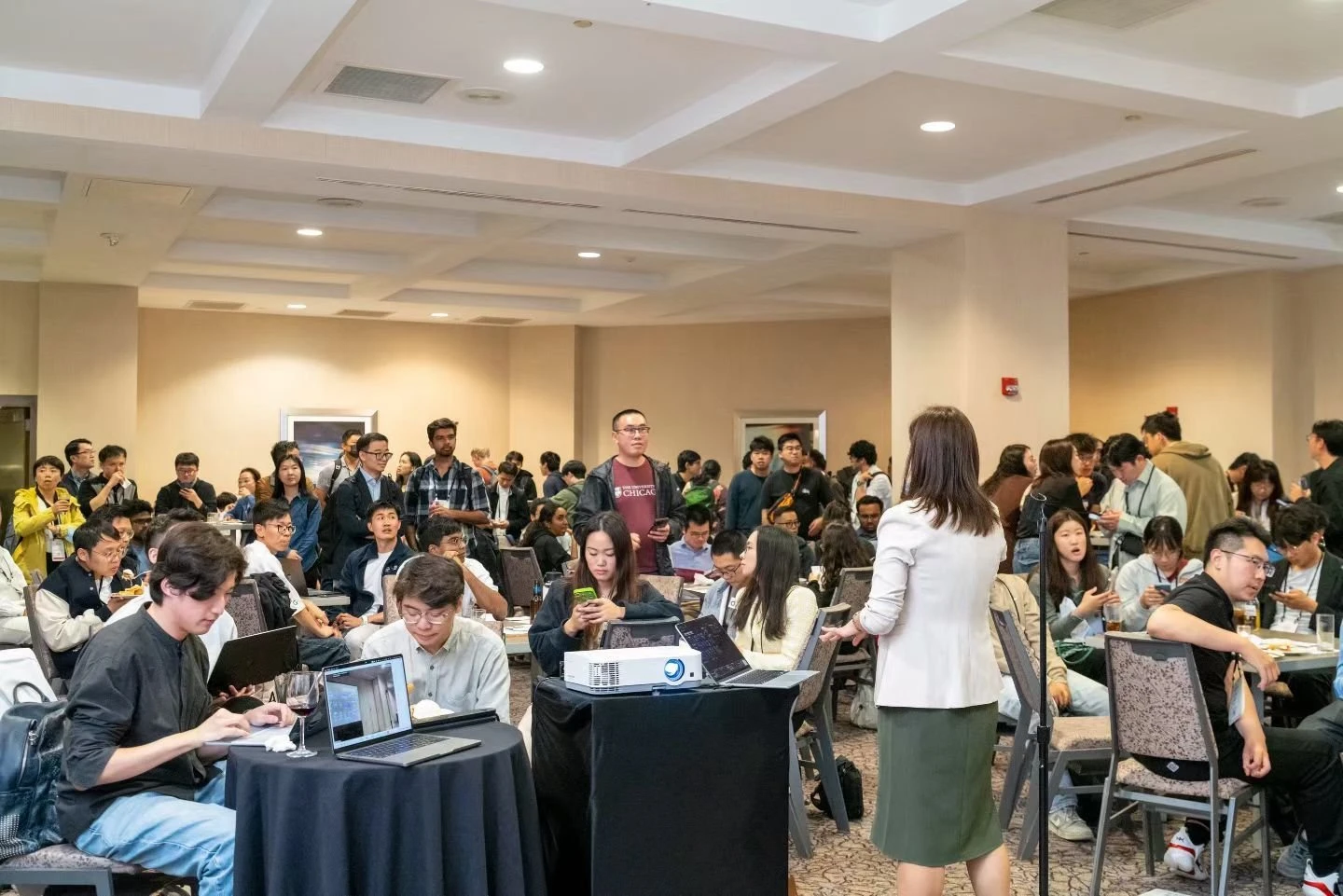
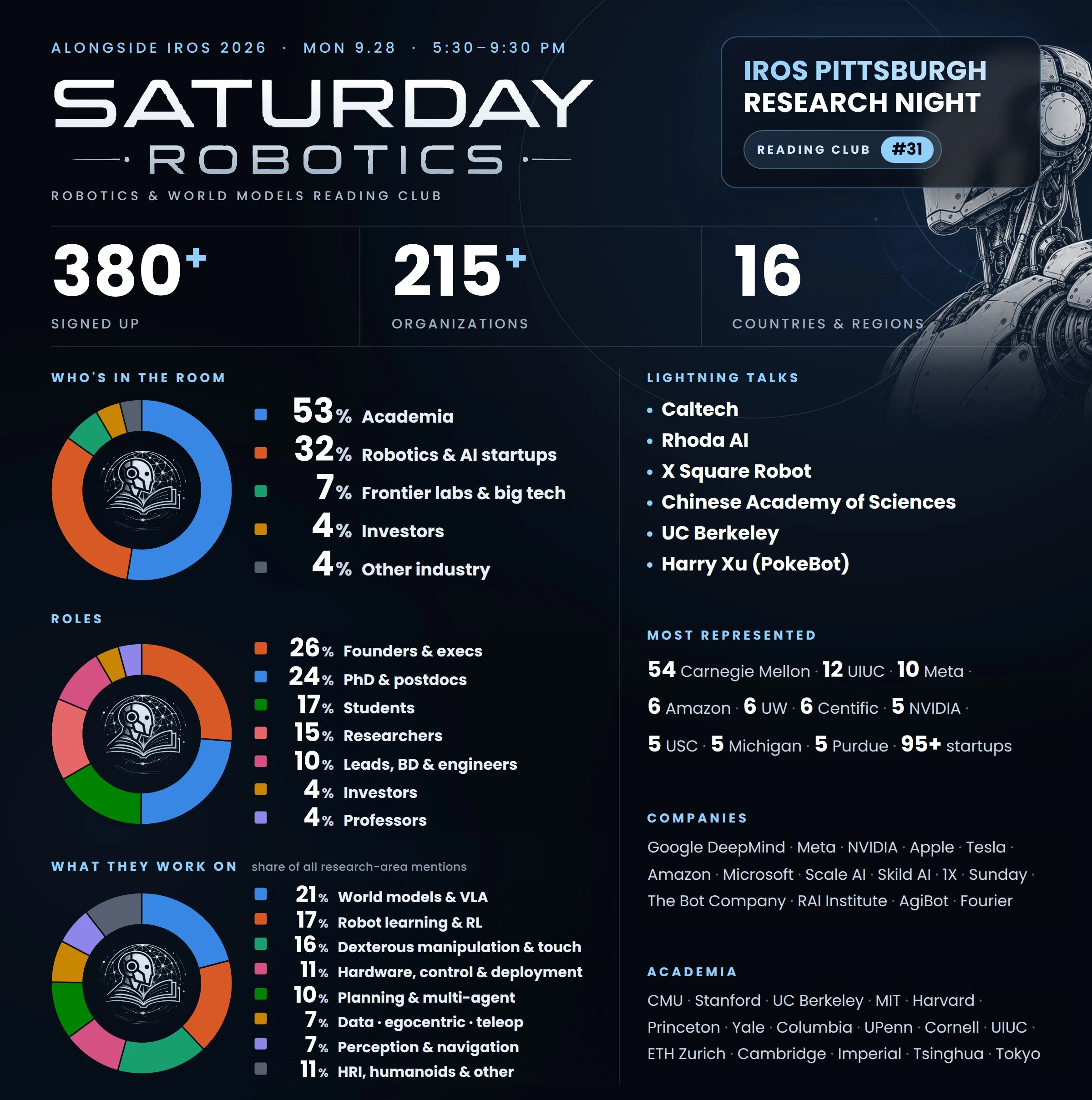
On September 28, 2026, while IROS 2026, the IEEE/RSJ International Conference on Intelligent Robots and Systems, was under way in Pittsburgh, Saturday Robotics hosted a Robotics Research Night. After the day’s academic program ended, researchers, founders and investors moved to another venue to continue the discussion in lightning talks of about ten minutes each, on robot safety, reinforcement learning, world models and embodied intelligence. According to the event’s registration records, nearly 400 people from more than 200 organizations in 15 countries and regions signed up.
Two days earlier, Zhu had been in San Francisco hosting the club’s regular Saturday session. Afterwards he took a red-eye to Pittsburgh by way of Chicago, then attended IROS, met with researchers, and took the evening’s program online as well. “I’m close to the limit of my bandwidth,” he says.
That pace mirrors robotics research itself. A researcher may spend six months on experiments; by the time the work has gone through submission, review and publication, the original idea may be a year behind. General-purpose models such as GPT-6 Astra are also rewriting the value of whole lines of research: scene modeling, code and evaluation work that robotics researchers once did by hand may begin to be taken over by more general computer agents.
The “Cretaceous” remark does not mean that past papers have suddenly become worthless. It means researchers have to keep re-evaluating whether the problem they are solving is still a problem, and whether a paper accepted at a top conference still sits at the frontier of what systems can do.
It also helps explain how a robotics reading club grew so quickly in just six months.
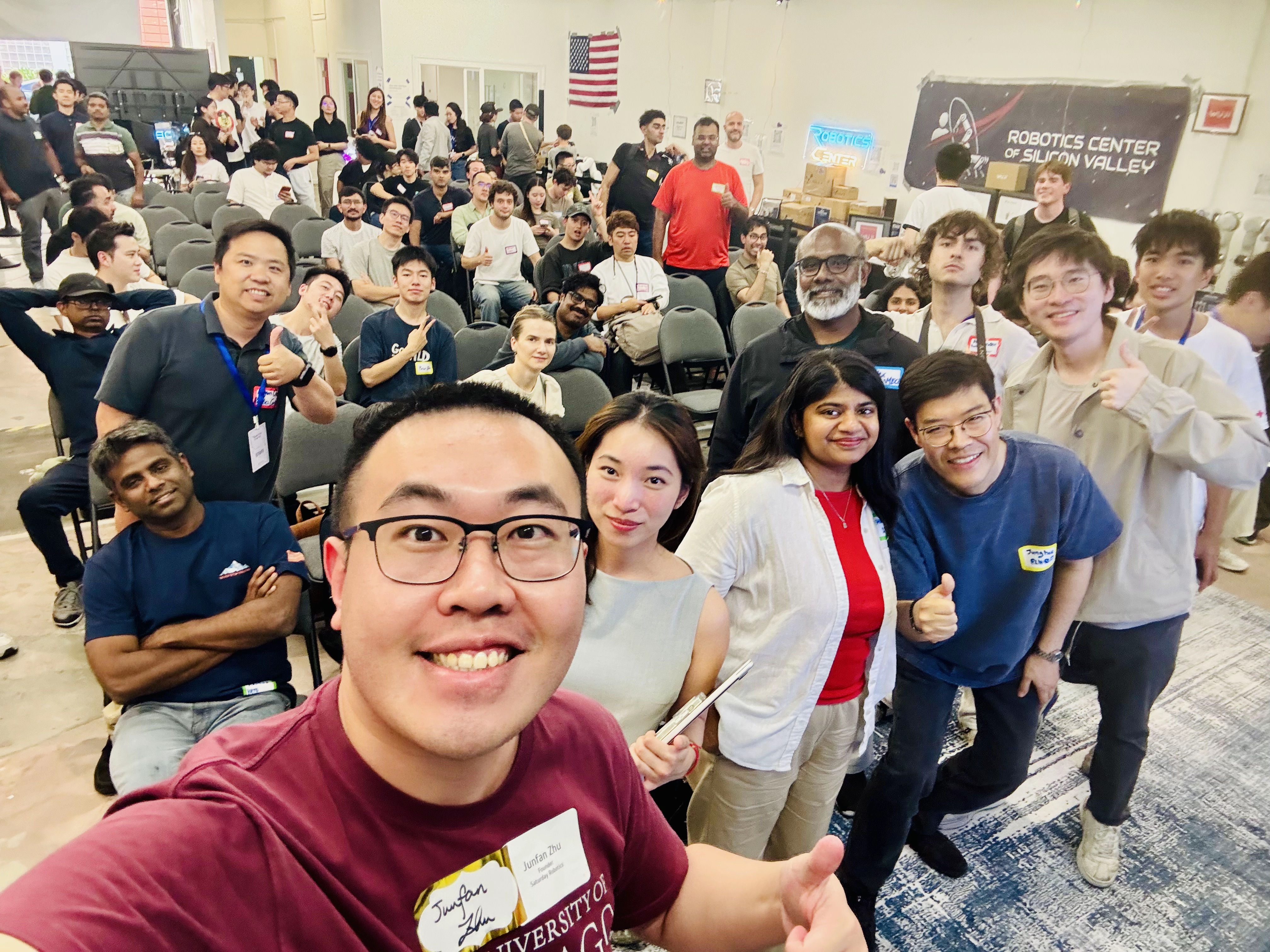
Saturday Robotics started in the San Francisco Bay Area at the end of March 2026. The first session was meant to gather 30 people in a cramped electrical room; two days after the registration link went out, nearly 100 had signed up, and the team had to find a new venue at short notice.
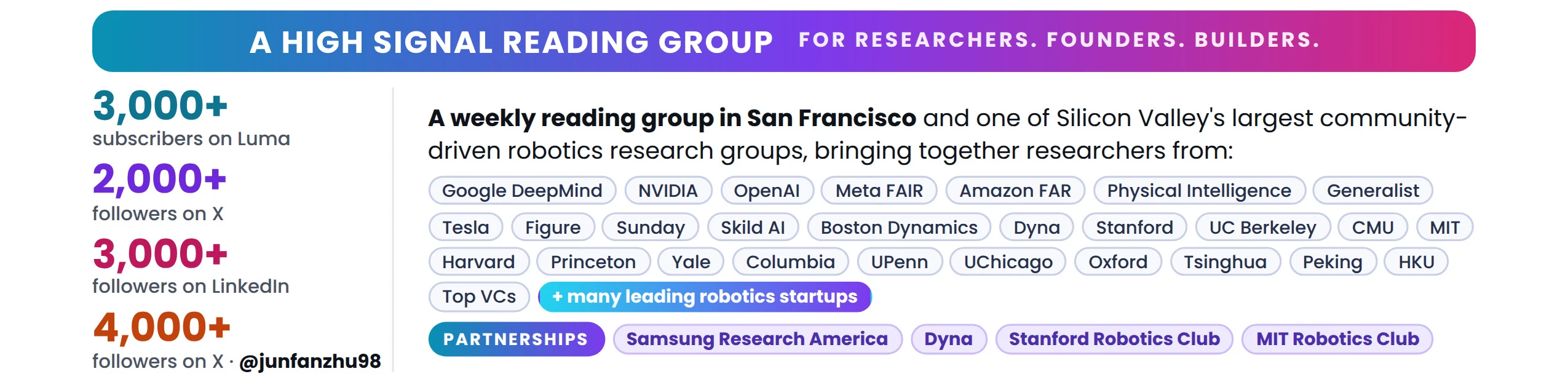
By October 3, it had held 32 sessions, according to its public events page. As of mid-October, Zhu says, it has more than 3,700 subscribers on Luma, roughly half of them founders and half researchers. Those figures measure the size of the community, not attendance at any single session; but the pace of events and the list of speakers are enough to show its pull in the Bay Area robotics community. As founder and program chair, Zhu is responsible for the club’s technical program: he chooses each session’s topic, invites the speakers, designs the format and moderates the discussion.
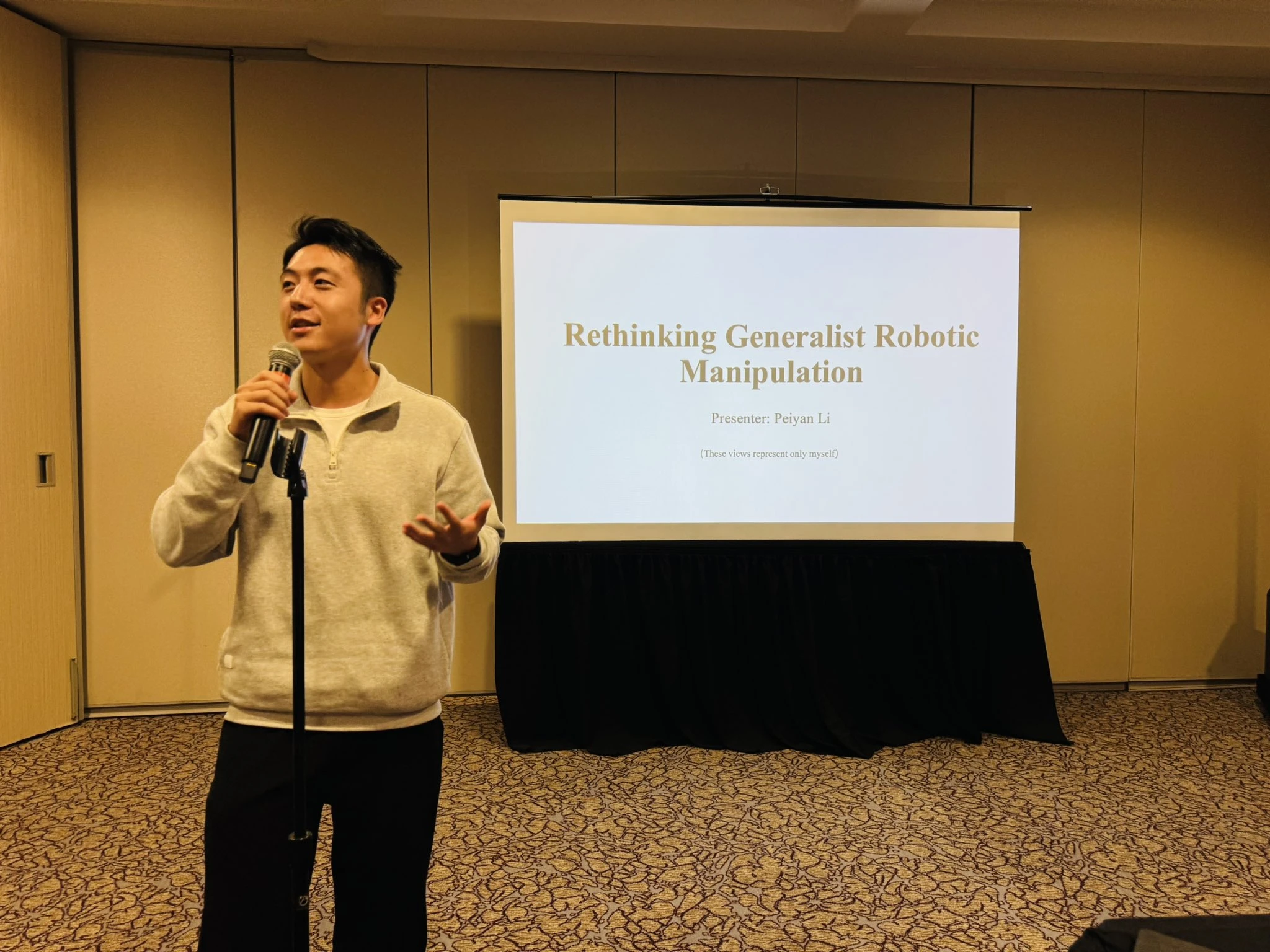
Speakers have included Zhaoshuo (Max) Li, technical lead for robotics and world models on NVIDIA Cosmos; Jason Ma, co-founder and chief scientist of Dyna Robotics; and Professor Kris Hauser, who leads the Robot Intelligence Lab at Samsung Research America. Samsung Research America and Dyna Robotics are among the organizations that have co-hosted sessions with the club. “Glad to co-organize Saturday Robotics reading club #20 with Junfan Zhu,” Nan Tian of Samsung Research America wrote on LinkedIn. “We had a full house yesterday at Samsung Research America (SRA).”
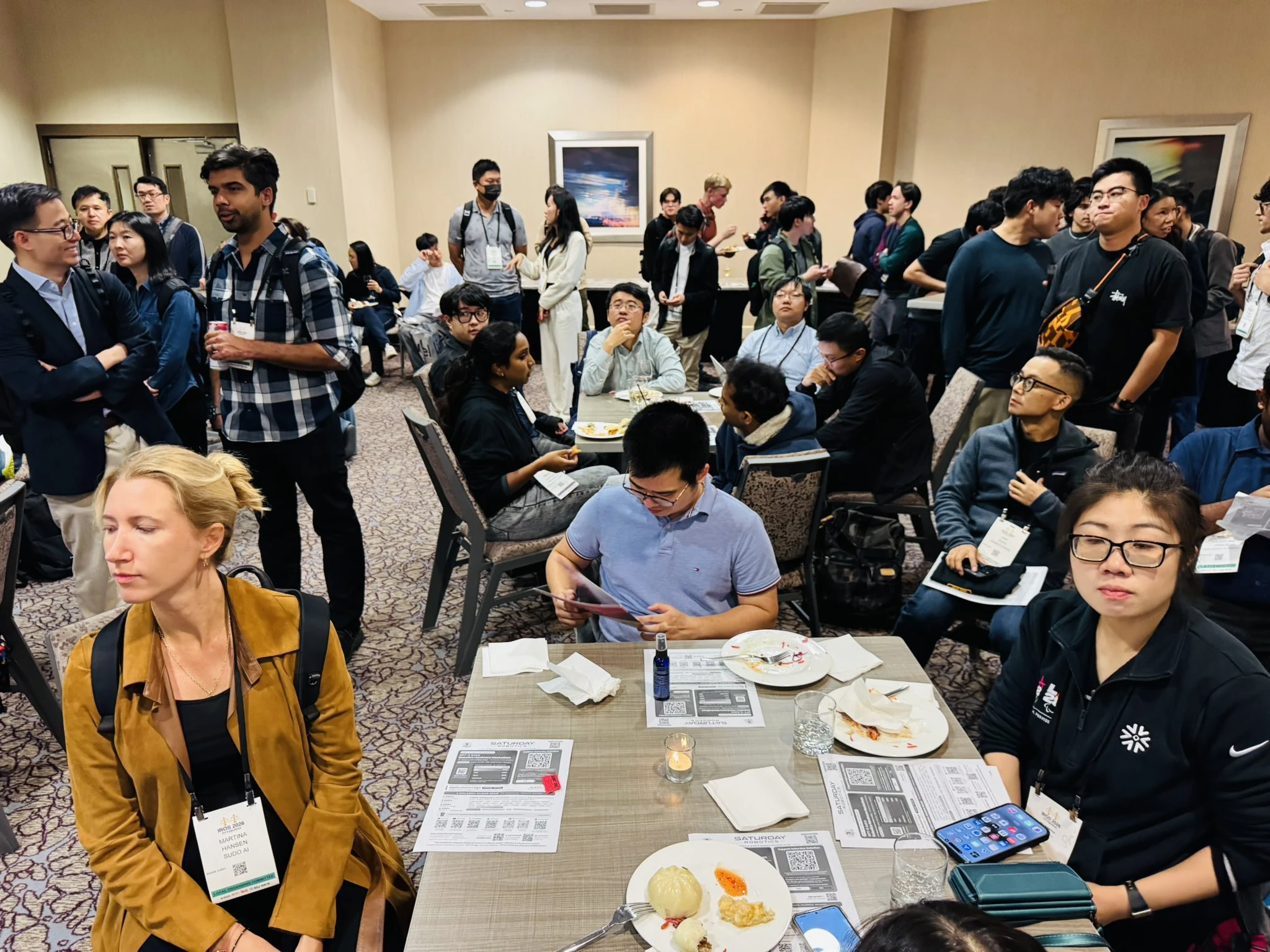
A research night the club held in Denver during CVPR 2026, the IEEE/CVF Conference on Computer Vision and Pattern Recognition, drew 624 applications, of which 317 were admitted, and Zhu selected six lightning talks from 43 proposals. In July, he also organized “World Models for Robotics: Bridging Graphics, Simulation, and Physical Intelligence,” a Birds of a Feather session that ACM SIGGRAPH 2026 accepted and listed under his name in its official program.
Zhu studied mathematics and computer science and has worked in quantitative finance and autonomous driving. His research focuses on how to evaluate AI systems that operate in the physical world.
He is a co-author of IEDD, an interactive driving dataset with a tiered benchmark for autonomous driving, which Scientific Data (Nature Portfolio) accepted in July, and he contributed quantitative-finance tasks to Agents’ Last Exam, a multi-institution benchmark for long-horizon AI agents that was accepted to the NeurIPS 2026 Evaluations and Datasets Track. He reviewed for that NeurIPS track and for the EMNLP 2026 Industry Track, and Manning Publications has twice asked him to review book proposals on world models. At IROS this year, he served on the program committee of the Physical World Models for Scaling Embodied AI (PWMS) workshop and chaired both of its oral sessions and its WorldArena 2.0 challenge session. In July, he was invited to moderate a CEO panel on physical AI in manufacturing at the AUTONOMOUS 2026 summit. He describes himself as both “headmaster” and “student” at Saturday Robotics: rather than handing the industry a single roadmap, he brings people from different camps into one room to see which debates experiments and real-world deployments can move forward.
We spoke with Zhu for more than an hour during IROS in Pittsburgh. The conversation moved from how the club began to the differences between the Chinese and American robotics ecosystems, and on to GPT-6 Astra, simulation, touch, benchmarks and the shifting value of data companies. He offered no definitive answers to many of our questions. In his view, at a stage when little can yet be proven or disproven, letting disagreements surface fully is more valuable than settling on a consensus too early.
What follows is our conversation with Saturday Robotics founder Junfan Zhu, translated from Chinese and lightly edited.
A reading club that went from 30 to nearly 100 people in two days
Q: Saturday Robotics is only six months old. Why has it grown so fast?
**Zhu: **We never set out to make it this big.
We held the first session on March 28. I had just moved from the South Bay to San Francisco, and at first I only wanted an informal get-together with friends. The building I was living in at the time had an electric power room: very cramped, no sunlight, a real “little black room.” The plan was to start with 30 people and slowly grow to 60.
I posted it on Luma on a Thursday, and by Saturday nearly 100 people had registered. There was no way that little room could hold them. Aurora found a space offered by a VC firm, and a get-together with friends turned into a proper event.
The first session was about JEPA, and Yann LeCun liked and reposted it. We later realized that people really did need a forum like this. The field moves fast, companies’ approaches haven’t converged, and people need a place to discuss the newest work.
Q: But one event that happens to hit a hot topic could be luck. Looking back on these six months, what drove the growth most?
**Zhu: **We don’t have the fanciest venues, and our budget and hands are limited, so we put our energy into the content and keep the format simple. Two things really matter.
First, the content has to be at the frontier; it needs a hot take. That is the only way to draw real researchers and builders who come to debate. If it were just an ordinary startup demo day, Silicon Valley has those everywhere; it wouldn’t be something people drive in for every Saturday.
Second, our own social media. I post diligently on LinkedIn and X so that people outside San Francisco can see what we do. Researchers in Munich and Zurich later reached out to me, and researchers in China come across our events on Xiaohongshu (RedNote). Technical taste decides who wants to come; consistent sharing decides whether the circle can grow beyond one room.
Q: An academic community that grows too fast can also become a small circle of people who validate one another. How do you avoid an echo chamber?
**Zhu: **I thought about that from the start. Silicon Valley has plenty of so-called inner circles where a group only talks among itself. I wanted this to be more open, and especially to bring in young people.
In the internet era, the longer someone has been building experience, the bigger their voice. Robotics isn’t quite like that. Many young researchers are playing key roles in new work. Our test for choosing a speaker is whether they have a hot take: whether the work is new enough, has real insight, or has started an important debate.
Someone can be fresh out of school, or even an intern. We invite them not because they are a senior professor, but because they did work that has an impact on the field.
Q: But “hot takes” can also turn into chasing buzzwords. How do you decide a new direction is worth discussing?
**Zhu: **The problem right now is that many approaches can be neither proven nor disproven yet.
Take the speakers at our fifth and sixth sessions. Their work was very different; you could even say their technical approaches were worlds apart, and each had questions for the other. What we do is have one side give the keynote and then let another group question them. These methods may each have scaled up some capabilities already, but that doesn’t let us declare a final winner.
As long as the work itself matters and there is a real disagreement to explore, it’s worth putting on the table. It isn’t the reading club’s job to pick the answer for everyone.
Q: Do you see yourself as an event organizer or a researcher?
**Zhu: **Both. I have been doing independent research all along, on how to evaluate AI systems in the physical world, writing papers and reviewing; the reading club is what I spend the most time on right now.
Robotics is very hard to master across the full stack. I mostly look at problems from the angle of algorithms and world-action models, but hardware, simulation, touch and motors are just as important to robotics, and many of those areas are not my specialty.
So I’m both “headmaster” and “student.” Everyone has blind spots; becoming a full-stack roboticist is incredibly hard.
Q: Three years from now, will Saturday Robotics still be a community, or will it have become some kind of industry infrastructure?
**Zhu: **I hope it can contribute across different areas of robotics.
On the research side, we are already collaborating with some community members, and some researchers are preparing new benchmarks. On the industry side, we want to move from a fairly theoretical reading club toward deployment: for example, hardware hackathons where hardware companies, data companies and researchers build things together instead of only talking about papers.
Further out, it could become a venture studio, a bridge between founders, VCs, data, compute and hardware that helps early-stage Bay Area robotics teams turn their research into real, deployed products faster. But I don’t want to lock in the form yet. We’ll try something first, collect feedback and iterate.
China isn’t only hardware, and America isn’t only models
Q: You often describe Saturday Robotics as a bridge between the robotics ecosystems of China and the United States. Where do the two really complement each other?
**Zhu: **Chinese companies do have a very big advantage in hardware, supply chains and industrial capacity. Many American companies need to work with Chinese companies, or go to Shenzhen for supply chains and talent.
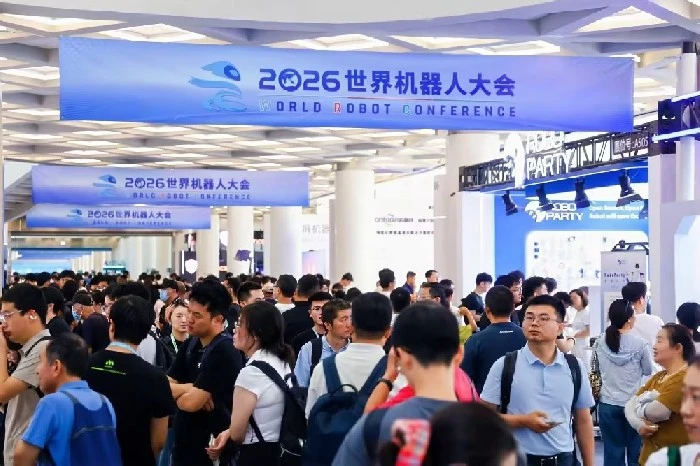
But China is by no means only hardware. Look at who is publishing at top conferences such as NeurIPS and you see strong research from universities in mainland China and Hong Kong and from Chinese companies. When I ran an event in Beijing during the World Robot Conference (WRC), I could also feel how cutting-edge many researchers’ views were.
What makes the Bay Area special is its many small companies that are very strong in one niche. Their founders have their own insights and sit in the same ecosystem as researchers at Google DeepMind, NVIDIA, OpenAI, Amazon and other large companies. What we want is to make Silicon Valley the center where the world’s robotics researchers come together: researchers and engineers from China bring firsthand experience in hardware, supply chains and industry, teams in the Bay Area bring frontier models and algorithms, and everyone compares, in the same room, what actually works.
Q: Was your first attempt to connect the two sides directly the event you held in Beijing during WRC?
**Zhu: **Yes. We invited some industry and academic researchers from North America to join remotely. The problem was that serving both Beijing and California time zones meant the event could only happen at an hour when “both countries are sleepy.”
I got up at 6 a.m. in San Francisco; some speakers only came online at 7. In Beijing, the discussion ran from 10 p.m. into the early hours, and I heard some people stayed until 1 a.m. They had spent the whole day walking the exhibition and still stayed to listen. I was very moved. A cross-border community isn’t about putting both sides’ names on one poster; the first things you run into are very concrete costs of time and organization.
Q: You have run events at WRC in Beijing and at IROS in Pittsburgh. Comparing China and the US, what is the most obvious difference?
**Zhu: **I don’t want to reduce it to “Chinese hardware, American software.”
At this IROS there were many Chinese companies from Suzhou, Beijing, Shanghai and Shenzhen. Some keep a low profile but are already very capable. At CES, CVPR and IROS you see more and more Chinese companies, and they are showing not just supply chains but their own research and innovation.
The American hardware ecosystem is relatively thinner, but it has very strong academic, foundation-model and startup ecosystems. It isn’t one side exporting capability to the other; each has its own comparative advantages.
Q: But “connecting China and the US” can easily stay at the level of events and socializing. What visible results do you hope for?
**Zhu: **We have already seen collaborations form among members: academic collaborations, and startup teams in the Bay Area that have found customers, investors, and partners for data, hardware and compute here.
We have a fairly stable community in San Francisco and have also tried events in Beijing, Denver and Pittsburgh; our next research night will be in Austin during the Conference on Robot Learning (CoRL 2026). In the future we could go to Seattle and Boston, and to research hubs such as London, Munich and Zurich.
Our core team is still lean: I choose the topics, invite the speakers and moderate the discussions, and our co-hosts and volunteers run the events together. To become a truly global network, we would need more people and a more stable way of organizing.
GPT-6 Astra raises the stakes for simulation, but the real world isn’t going away
Q: What was the most noteworthy technical topic at this IROS?
**Zhu: **GPT-6 Astra has brought a lot of new ideas. One is that real-to-sim-to-real may become more important.
It is very strong at computer use and at 3D work in tools such as Blender. Building 3D assets, writing scenes and setting up simulations used to take a lot of manual work. If an agent like that can reliably break the work into small atomic actions and automate parts of scene building and parameter tuning, experiments that used to take a lot of manual effort could become much cheaper, and some research that wasn’t feasible before could become feasible. That still has to be shown in practice.
I didn’t use to put this much weight on simulation. Since GPT-6 Astra came out, I take that path more seriously. But there are still two camps: one thinks it will truly change robotics research, the other thinks it has only made a small splash. I’m still watching.
Q: Besides simulation, you also emphasized in-context learning this time. Why does it matter now?
**Zhu: **Skild AI and Generalist’s GEN-1.5 both emphasize in-context learning. Ideally, you no longer run a full round of training for every new task; you give the robot one or a few examples, and it learns the new task in context.
But it is also a contested topic. Some think in-context learning is a capability robot foundation models must have; others think a true foundation model should aim straight for zero-shot and shouldn’t require on-site examples. I think we need more research and deployment results to know whether it is a path to generalization or just another form of on-site adaptation.
Q: You once said robotics still needs an ImageNet-style “benchmark moment.” Since Astra, you seem to have played that down. Did it change your mind?
**Zhu: **Those are two different topics. This time I added some material on GPT-6 Astra, so what I had said about benchmarks got less emphasis, but I still think benchmarks are very important. They are just very hard to build right now.
Language models get huge amounts of training data from the internet, and evaluating them is relatively simple. Robotics involves contact, force and a very high number of degrees of freedom. Take opening a fortune cookie: two attempts can look almost identical on video, but press a little harder and the cookie shatters. That kind of difference is hard to capture with ordinary video and a single score.
Q: So robotics won’t have one unified benchmark?
**Zhu: **I think there will be many benchmarks, and that is necessary, but it is unlikely that one company builds a single benchmark that rules them all. In autonomous driving, the two projects I’ve co-authored with the same research team follow that logic. IEDD, which Scientific Data accepted this year, collects interaction-dense driving scenes into a dataset with a tiered benchmark. SSP, our follow-up preprint, builds matched versions of the same safety-critical event, such as a cut-in or a crossing, in synthetic data, in simulation and in the physical world, and checks whether a driving model behaves consistently across the three. The results challenged a common assumption, that a model will necessarily do better in the physical domain. My part in both was the evaluation design.
Different benchmarks will focus on different problems: some on safety, some on dexterity, some on long-horizon tasks. The real world also has a lot of context that is hard to define. If a cat jumps onto a robot, should the robot take it down or let it stay? If a baby reaches for a cup, does the baby want a drink or just want to play with the cup?
If a robot ranks first on benchmark A and third on benchmark B, you can’t just compare the scores. Even when two attempts are both recorded as failures, getting it completely wrong and coming very close to success mean different things. Robotics hasn’t had its benchmark moment yet.
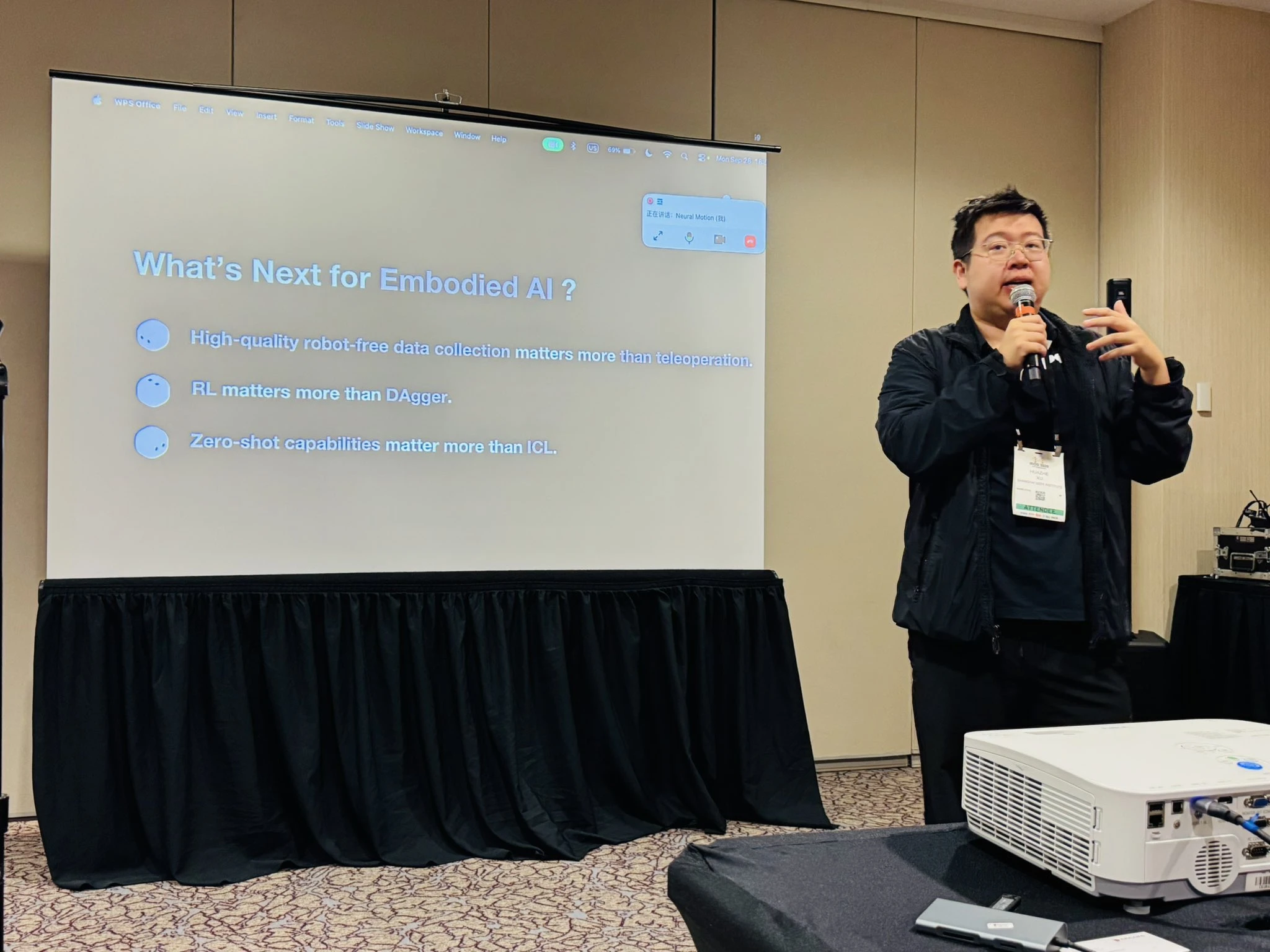
Q: If general-purpose models can supply ever-stronger perception, reasoning and simulation, where should robotics companies place their value?
**Zhu: **Companies and products that are truly valuable must ultimately serve people. A robot can go into homes to do chores and care for older people, or into factories to raise productivity and free up labor.
But to really enter everyday life, reliability is very hard. In a demo a robot can fold clothes or towels nicely; once it is in a home, it can’t break a cup every few days. Every additional nine of success rate can multiply the work required. That is also the direction I most want to push: using better evaluation methods to find out where a robot will fail before it ever enters a home or a factory. Concretely, that means tests that tell a near-miss from a complete failure, that check whether a model that works in simulation still works in the real world, and that turn failure data into test cases instead of throwing it away. I want those methods to be open, so that university labs and startups can use them, not just the largest companies.
I think deployment itself will be a moat. In the home especially, a company has to actually get in to start the flywheel of data and product iteration, but it needs good enough reliability before it can get in. It’s a chicken-and-egg problem.
Q: Does that mean the truly valuable companies will be closer to contact, touch, dexterous manipulation and final execution?
**Zhu: **Touch is an underrated direction. Many omni models already handle vision, language and other modalities, but none has really brought touch into a system that can scale. Everyone may be waiting for the first person brave enough to try.
Another direction is agentic robotics. GPT-6 Astra has strengthened interest in code-as-policy. But can agentic abilities also be applied to dexterity? Can a robot, the way it calls a tool, learn dexterous tasks it has never seen through language prompting? There is still relatively little work on that.
The last stretch of the deployment gap may still need RL and fine-tuning. Some companies simply throw away failure data, which I think is a huge waste. How to turn suboptimal policies and failure data into something valuable is a question for both industry and academia.
Q: So is GPT-6 Astra better suited to be a robot’s “brain,” or a “supervisor” that schedules and evaluates?
**Zhu: **You can turn that question into this: will large-model companies take over robots, or will robotics companies develop their own backbones?
Researchers were debating exactly this last night. Robotics companies would of course rather own the whole system, with large models in a supporting role. But I’m still watching.
Running the reading club is a bit like being a food critic: I taste every kind of research, viewpoint and school, hoping to form a picture of the whole landscape. It also helps me judge which direction Saturday Robotics and my own research should bet on next.
When new technology appears, it makes me swing and reweight my earlier views. Vision and language models are still developing in parallel, each lifting the other. I don’t yet know who will end up taking over whom.
Q: If agents can build simulation environments and generate training data themselves, and AI then evaluates the results, could that create a faulty closed loop, in which a system generates its own errors and then reinforces them?
**Zhu: **That is a very important question, and I’m not sure of the answer.
Some companies now put great weight on simulation, selecting data through simulation and their own evaluation pipelines. Some teams report using almost no teleoperation data and have still demonstrated tasks such as moving boxes and pressing elevator buttons. So that approach has some observable results behind it; it isn’t just an idea.
But the key is diversity. If a system iterates only on simulation it generated itself, it can easily become garbage in, garbage out, with data diversity shrinking over time.
Say I toss a notepad onto the chair across from me and it bounces back and hits my head, or a robot pushes open a café door with its elbow and the door swings back into it. These things are rare, but they really happen in the real world. It is very hard to find that kind of out-of-distribution data through simulation alone.
Narrow, specific tasks, such as pick-and-place or repetitive factory operations, may be learned well mostly in simulation. For more general-purpose robots, I’m not sure simulation alone can provide enough diversity. The system also needs the ability to learn quickly when it meets an unfamiliar situation, instead of trying to contain all the world’s data in advance.
Before a paper is published, the research question may already have changed
Q: With general capabilities like GPT-6 Astra, will some robotics papers at IROS that were valuable suddenly lose their meaning?
**Zhu: **Yes. This era changes too fast. Something you bet on a few years ago can be wiped out by a new technology. A topic someone spent a long time on, even part of their career, can change very quickly.
I don’t mean GPT-6 Astra specifically; many new technologies can have this effect. They take weight away from some older topics and at the same time create new questions. Overall they still move the field forward, but researchers feel exhausted and dazzled.
You have to keep asking where a piece of research sits in today’s field. Ideas from two years ago can sometimes look as if they came from the Cretaceous, or the Stone Age, in today’s robotics.
Q: Then should researchers just wait two years, until model capabilities are clearer, before deciding what is worth doing?
**Zhu: **Someone joked that you could lie flat now, go to sleep, wake up two years later as if from a time machine, and it might be GPT-10, and a lot of past work would no longer need doing.
But I still think you have to stay in the wave and watch. Watching is tiring and burns a lot of brain cells, but if you don’t keep reading new papers and following new models and deployments, it is even harder to tell where the field is going.
Q: Is this also weakening the value of traditional academic conferences?
**Zhu: **Conferences and papers are still very valuable references, but iteration is now so fast that when a paper becomes public, it may reflect an idea from a year earlier.
Researchers spend six months building something, then go through submission, review and publication. Reviewers themselves may not understand a new direction, or their views may still be two years old. Some very new work is hard for the existing review process to recognize in time. It may be rejected because it is too far from what people expect, and only get the attention it deserves later.
That is why people pay more attention to workshops, discussions on X, and fast exchanges such as reading clubs. A workshop may be about what is happening today, not a snapshot of research from a year ago.
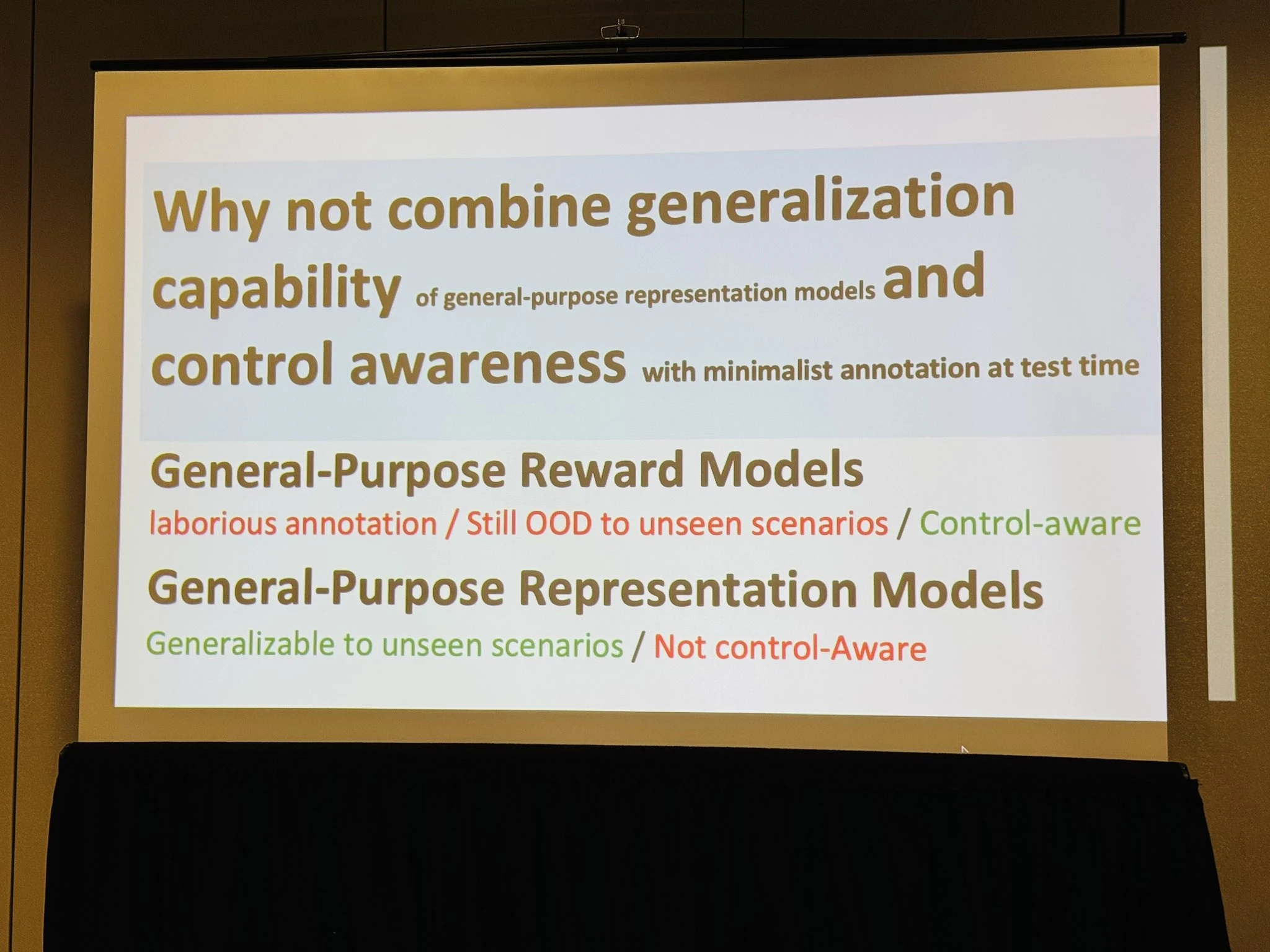
Q: Will the division of labor between academia and industry change as a result?
**Zhu: **Academia has many novel ideas, but it often lacks the resources needed to scale them up industrially.
For example, academia found that egocentric human video is very useful for robots, but a research team can only show that it works at the scale of its limited GPUs and data. Whether it keeps improving when data and compute grow a thousandfold or ten-thousandfold, whether there is a scaling law, has to be verified by industry.
That is also why many young researchers move quickly into industry. At school they may feel they don’t have enough room; at a company they can command thousands of GPUs or more and truly scale up bigger ideas.
But robotics research ultimately has to face the deployment gap. However fancy a foundation model is, in the end it has to enter the real world and make robots actually do things. Academia and industry are not replacing each other; they have to build a faster loop between them.
Q: If general-purpose models can generate hundreds or thousands of simulation variants at once, will data companies’ moats be greatly weakened?
**Zhu: **The value of some traditional 3D assets may change. People used to set many physical parameters by hand: for example, how much force it takes to start opening a microwave door, and how the door should then swing open naturally. If a computer agent can do the modeling and parameter tuning that people do today, I would reconsider whether such assets are still worth buying.
But another possibility is that demand for data grows even larger. Jensen Huang once used a radiologist analogy: as medical imaging improved, radiologists didn’t disappear; scans became cheaper and more accessible, and more people used them.
Something similar could happen in robotics. Dexterous hands, touch and different embodiments will demand data across more dimensions. As the cost of generating data falls, companies may not buy less data but use more.
What gets reshuffled may not be the data business itself but the niche built on manually piling up 3D assets and physical parameters. But there is no answer to that yet.
Q: Is running this reading club also a way of finding your own answer: which bets deserve to become long-term technical directions?
**Zhu: **Yes. I wish I had “a gaze deep enough to pierce the haze of history” and could see which directions will truly matter. That sounds lofty, but to be frank, I’m still looking through the fog.
What I can do is put the newest research, the views of different schools, and feedback from academia and industry side by side. When new technology appears, I may waver and revise my judgment. That isn’t necessarily bad. In a field that hasn’t converged, committing to one path too early may be more dangerous than admitting you are still in the fog.